

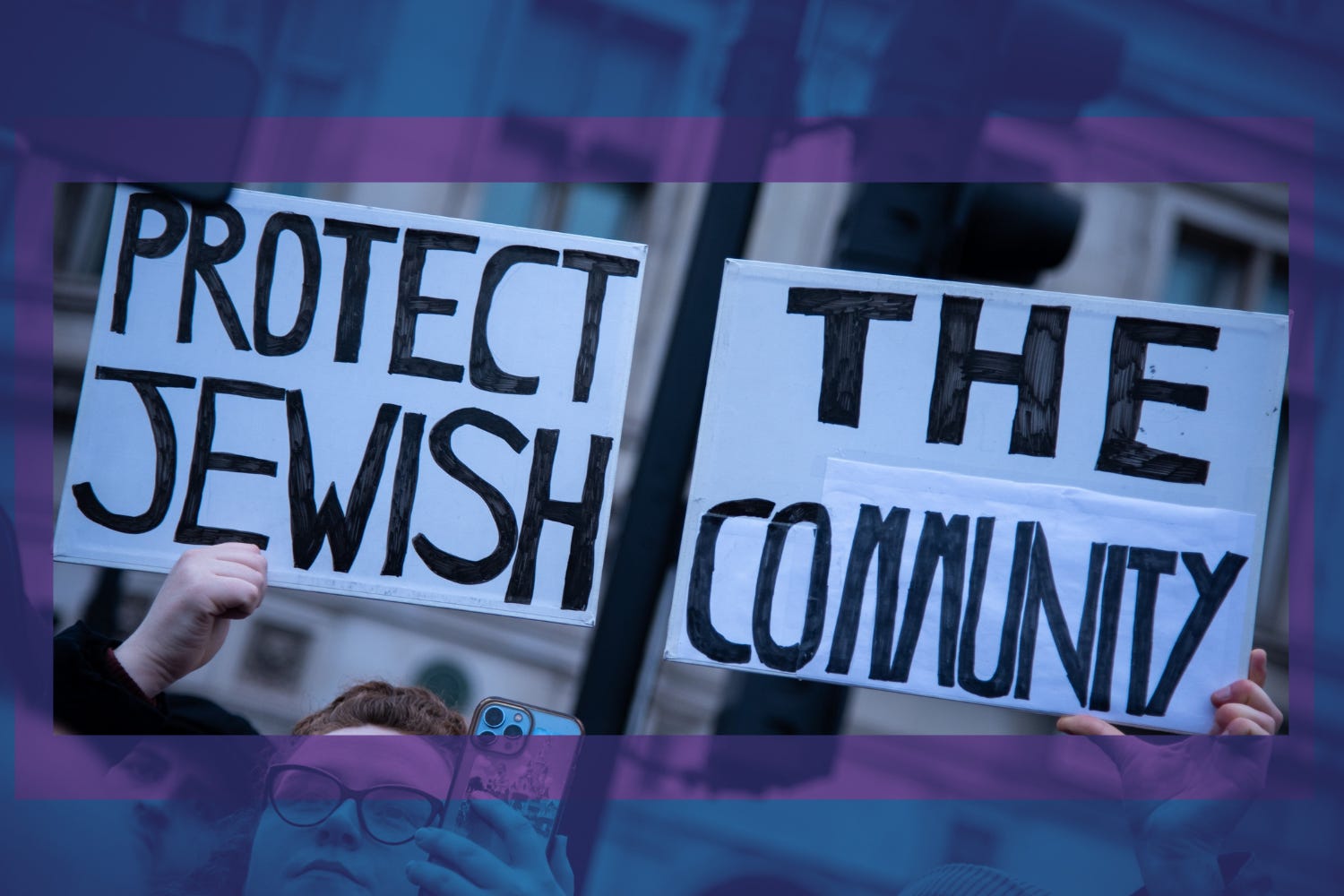
After a staff meeting touching on antisemitism this week, a young mother on our team pulled me aside to share that, at parents night at her kids’ Jewish day school, the topic taking the most time on the agenda wasn’t the curriculum or the homework – it was security. That’s not OK.
At a small dinner for J Street supporters this week, a 97-year-old Holocaust survivor painfully shared that he’s experiencing real fear as a Jew in this country – something he never expected to feel again in his life.
There isn’t a meeting or event I attend these days where I don’t hear this same concern from J Street supporters: we are looking over our shoulders. We are wondering whether our children are safe.
Antisemitism is real. It is frightening. It is dangerous.
We have to talk about - and address - it.
But we have to hold another truth at the same time: our fear of antisemitism cannot become a reason to shut down debate about Israel, Palestine, Gaza and the West Bank.
So many of the protests causing fear and anger in the Jewish community are prompted by what’s actually happening in Israel and Palestine on the ground. It’s a reality that I – and so many others – have seen firsthand and written about.
There is a legitimate conversation to be had about Israeli government policy and actions not just over the past few years, but over decades. There are reasons to protest.
There are questions that need to be asked: What needs to be done to make Israelis safer and Palestinians free? What is America’s role? What should we be asking of Israel and of Palestinians, and what do we do if they don’t change course? How do we end the bloodshed, protect both peoples and create a future in which Israelis and Palestinians can live with security, freedom and dignity?
And we have to be able to discuss all of this without having the conversation shut down with a charge of antisemitism.
It seems not a day goes by now without a political or cultural figure publicly criticizing Israel and then facing accusations of antisemitism.
Criticizing Israeli policies and actions or publicly – even loudly – advocating for Palestine is not, in itself, antisemitic.
Sometimes criticism of Israel does cross that line. Sometimes it relies on antisemitic tropes or conspiracy theories. Sometimes people who claim to be criticizing Israel are really targeting Jews. We should call that out when it happens.
Too often, the Jewish communal reaction to criticism, however, is to level exactly that charge. The debate shifts from a conversation about what’s actually happening to one about the critic. It’s no longer “What’s wrong with Israel’s policies and actions?” It’s “What’s wrong with the Democratic Party?” – an argument I addressed last week following the new UK sanctions and the attacks on Foreign Secretary Ed Miliband.
Of course, some progressive activists are antisemitic. Others intentionally or unintentionally use antisemitic tropes. Some are ignorant about Jewish history or the Jewish connection to the land of Israel.
I’m not defending everything critics have said or how they’ve said it. Some have very troubling histories. Good friends of J Street do sometimes cross the line, and we tell them when it’s not OK. We work with them to do better, to better understand and to build bridges.
There’s another problem when the focus is only on progressive critics of Israel: antisemitism isn’t limited to one side of the political divide.
The Miami Herald recently uncovered a WhatsApp group involving conservative students at Florida International University and the secretary of the Miami-Dade Republican Party. Over two and a half weeks, participants used antisemitic and other racial slurs, discussed Hitler and renamed the group after what one participant called “Nazi heaven.” One participant wrote, “I would def not marry a Jew.”
In August, The Washington Post reported that a former staffer to Republican Rep. Mike Collins of Georgia had posted a swastika and an image of himself appearing to wear Ku Klux Klan robes. And just last week, the Post reported that a political director for Republican Sen. Jon Husted’s reelection campaign had used a photograph of Nazi SS soldiers as his Facebook profile picture and had participated in SS historical reenactments.
These are but a handful of examples of a problem on the right that has become serious enough that even Senator Ted Cruz has sounded the alarm. In a speech criticizing the growing influence of Nick Fuentes and Tucker Carlson in the conservative movement, Cruz said, “I have seen more antisemitism in the last 18 months on the right than at any point in my lifetime.” He warned that it is “gaining real purchase, especially with young people.”
Pointing this out isn’t whataboutism – and doesn’t minimize problems on the left.
What I am highlighting is how striking the focus on antisemitism on the left is given the racism, bigotry and white nationalism we are seeing on the right.
There’s an electoral context to this, too. I hear some Jewish Democrats saying they are not sure what to do come November.
But elections are choices, not referenda on whether every activist on one side of the political spectrum uses language we like, understands Jewish history as we do, or gets every argument about Israel right. Elections determine who governs and what policies our government pursues across a vast range of issues. Those choices deserve to be made with a clear view of the whole picture, not reduced to a judgment about a handful of activists or spokespeople.
The crisis of antisemitism is real. Let’s confront it seriously.
But let’s also be clear-eyed enough to distinguish criticism from hatred, disagreement from bigotry, and legitimate concern about Israel’s policies from hostility toward Jews.
And let’s make sure that in our understandable determination to confront antisemitism, we don’t lose sight of where the real dangers are – or allow our fear to shut down the honest conversations we need to have.
Wait! Before you go ...
J Street relies on grassroots support to fuel our mission: Fighting for Israeli-Palestinian peace and defending democratic values.
Unlike some other groups, we don’t have right-wing mega-donors, so every dollar makes a difference!
crucially important, and crystal clear
Very important message. Too many Jews think critical comments on atrocities the Israeli government commits are anti semitism. We need to be loud in our own criticism of Israeli policies in Gaza and Occupied territories. These are not good for the Jews. They are not Jewish values