

Seeing the Unseen
On a recent visit to Kibbutz Givat Brenner – a place that I called home for twelve years – I sat with my sister-in-law watching an investigative report on IDF regional defense units in the West Bank that had just aired on Kan, Israel’s public broadcasting network.
When it ended, I told her I was glad the report was in Hebrew. More Israelis needed to see it, especially before the elections.
She looked at me and said, “The people who need to see this never will.” She wasn’t being cynical; she was being honest.
And in that moment, she put her finger on the most fundamental problem I continue to encounter in the Israeli and American Jewish communities: The problem of the unseen.
The report we’d just watched was devastating. After October 7, the IDF distributed roughly 7,000 rifles to settlers drafted into regional defense units in the West Bank. The units consist of 8,000 ideologically driven individuals, with virtually no vetting and no clear chain of command. The report documented what followed: Uniformed men leading raids into Palestinian villages and violence without accountability. Its conclusion was chilling: When armed groups operate above the law, the line between soldier and partisan militia disappears.
This is not just a West Bank problem. No healthy democracy can tolerate it.
I’ve just returned from several days traveling through Israel and the occupied West Bank. I go back often and yet every time I return, I’m confronted again by the gap between what is happening and what most people – most Israelis and American Jews – are able or willing to see.
Walking through Tel Aviv, spending time on the kibbutz I love, I was struck once again by how insulated even the most left and center-left Israeli communities are from the reality unfolding forty minutes away. I thought too of my American Jewish community, many of whom have never traveled into the West Bank to see Palestinian suffering or the reality of the settler movement. Neither see the infiltration of the IDF by far-right extremists. The normalization of settler violence. The way Ben-Gvir and Smotrich’s ideological project is no longer happening on the fringes but at the center of Israeli state power, with IDF-issued guns, government-funded bulldozers and government budgets.
As I traveled in the West Bank, I stood at an overlook above E1 – the contested corridor east of Jerusalem where the fate of any future contiguous Palestinian state will largely be decided – and I watched the construction. Roads cutting through hills. Interchanges rising from the dust. To a casual observer, it looks like infrastructure or even progress. In reality, it’s a deliberate and systematic project to make annexation and occupation permanent.
I saw the construction of the Eastern Ring Road – designed to encircle the eastern perimeter of Jerusalem – which was built to connect settlements like Ma’ale Adumim to the Israeli road system. And then there is what Israeli officials have proudly named the “Sovereignty Road” – Route 4370 – a segregated highway running between the Palestinian communities of A-Za’ayem and Al-Eizariya, with separate walled lanes for Israeli and Palestinian traffic. Its purpose is not transportation; it’s to establish permanent Israeli control over Palestinian territory while maintaining the fiction that Palestinians can still move freely through the land they are being separated from. To the average eye, it’s just road construction. The reality it’s entrenching is almost entirely unseen.
That same day, we drove along Route 55, through the Seam Zone – territory caught between the Green Line and the separation barrier. The road is lined with Palestinian-owned plant nurseries. The planned expansion of Route 55 by Israeli authorities requires the expropriation of privately owned Palestinian land to connect Israeli towns and settlements, like Kedumim where Smotrich lives. What to an untrained eye will just appear like a road-widening project is something else entirely – the destruction of livelihoods and further annexation.
On the same trip, I visited the Palestinian Bedouin community of Khan al-Ahmar, just outside Jerusalem and the E1 corridor, in the shadow of Ma’ale Adumim. Its residents have been fighting for the community’s survival for nearly two decades. It has been the subject of legal battles, diplomatic protests and endless Israeli government proceedings. And just last month, Smotrich declared he will move forward with its demolition.
When I arrived, the village school was holding a celebration for the kids. There was music. Children were happily running around. The school serves over 170 elementary school kids. Along with the rest of the village, it too is slated for demolition, while the settlement outpost just across the street that terrorizes the village and its residents will remain untouched.
I spoke with one of the community’s leaders, Abu Khamis, whom I have met a few times before. He told me that he is terrified – not in an abstract way, but in the way of a man who has watched the political winds shift and knows what they carry. He believes Smotrich will destroy his village before the Israeli elections, calculating that the demolition will play well with his base. He acknowledged that the only reason Khan al-Ahmar still exists is international pressure and awareness. The moment the world stops watching, he said, it is over.
Their neighbors in Jerusalem and Ma’ale Adumim, minutes away, have almost no idea they exist or what their lives look like.
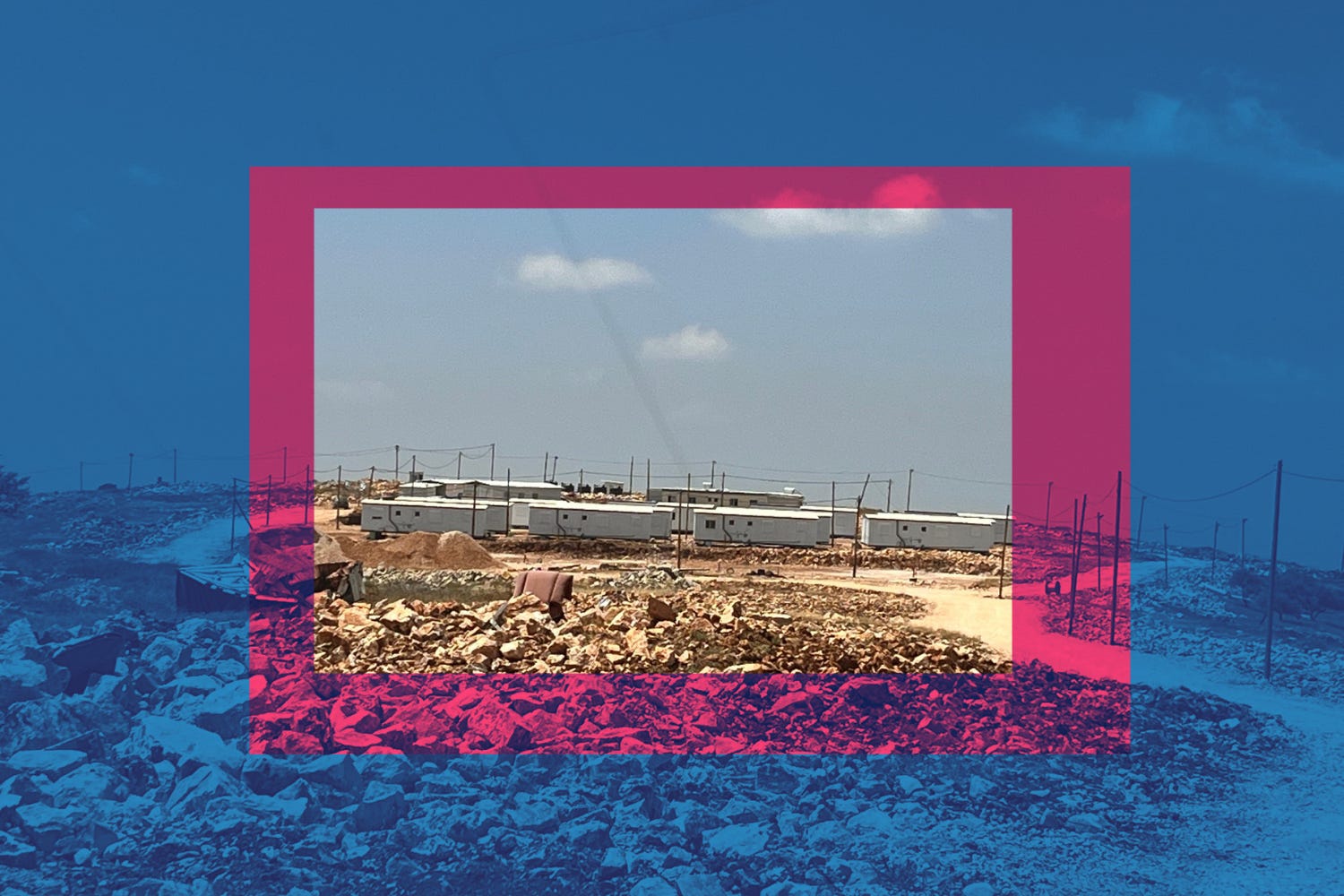
My last stops were in the northern West Bank. First to Homesh – one of four settlements evacuated by Prime Minister Ariel Sharon in the 2005 Disengagement, and reestablished this past March – what was once a single hilltop settlement and is now three. And then to a new settlement on Mount Ebal, just north of Nablus, where twelve caravans now overlook one of the largest Palestinian cities.
Mount Ebal is one of 34 newly established settlements in 2026 alone.
Most Israelis have no conception of where these settlements sit, or what it means for them to be there. But Palestinians in the area know. And the IDF knows exactly what it will cost in soldiers and resources to protect a settlement placed in some of the most deliberately provocative locations imaginable.
This is the settlement project in its current form: Not consolidating what exists, but pushing outward, upward, deeper.
I have been told that shining a spotlight on what I saw is dangerous and not “pro-Israel.” That it fuels antisemitism or amplifies Jewish infighting. That it turns the world against us. Or even that silence is the more responsible path.
But I have come to believe – more firmly with every trip, every conversation, every overlook and village and hilltop road – that the greater danger lies in the unseen. That by allowing these realities to unfold in the shadows, by turning away because looking is uncomfortable, we are not protecting Israel. We are handing a victory to the forces that are gutting it from within. We are allowing Smotrich, Ben-Gvir and their allies to operate without witness, without accountability, in a darkness they have cultivated deliberately.
I love this country. I lived there. My family is there. I still consider it my home. That is precisely why I will not look away or be silenced.
When the Israeli military is being reshaped by ideological extremists with guns and no accountability, my commitment to Israeli democracy demands that I speak. When Palestinian human rights are dismissed and trampled on, my morals demand that I speak. When a village school full of children is marked for demolition for political gain, my values demand that I speak.
We all must do everything in our power to make the unseen seen. Because for those who truly care about Israel's future, this must be the fight – not managing the conversation, not policing who speaks or how loudly, but actively joining the struggle to stop what is happening. The highest priority cannot be preventing the world from seeing or discussing these realities. It must be ending them.
If you appreciate the work J Street does, I hope you’ll consider making a grassroots contribution to ensure our voice is heard.
 |
|
This was one of the best essays I have seen. I lived in Israel back in the 70's and it was home to me. What Natenyahu's government has done in our name is a holocaust for the Palestinians. I cannot understand how our people after what we went through in World War 2; can do the same thing to another group of people. I so appreciate your perspective. Thank you.
Thank you, Adina, for your passionate and thought-provoking essay. Unfortunately, the essay underscores the very problem you address. You're preaching to the choir. Liberal Zionists have to vigorously broadcast this message to a larger audience. That's got to be the next challenge for JStreet: how to get these essays into the NYT and WSJ.