

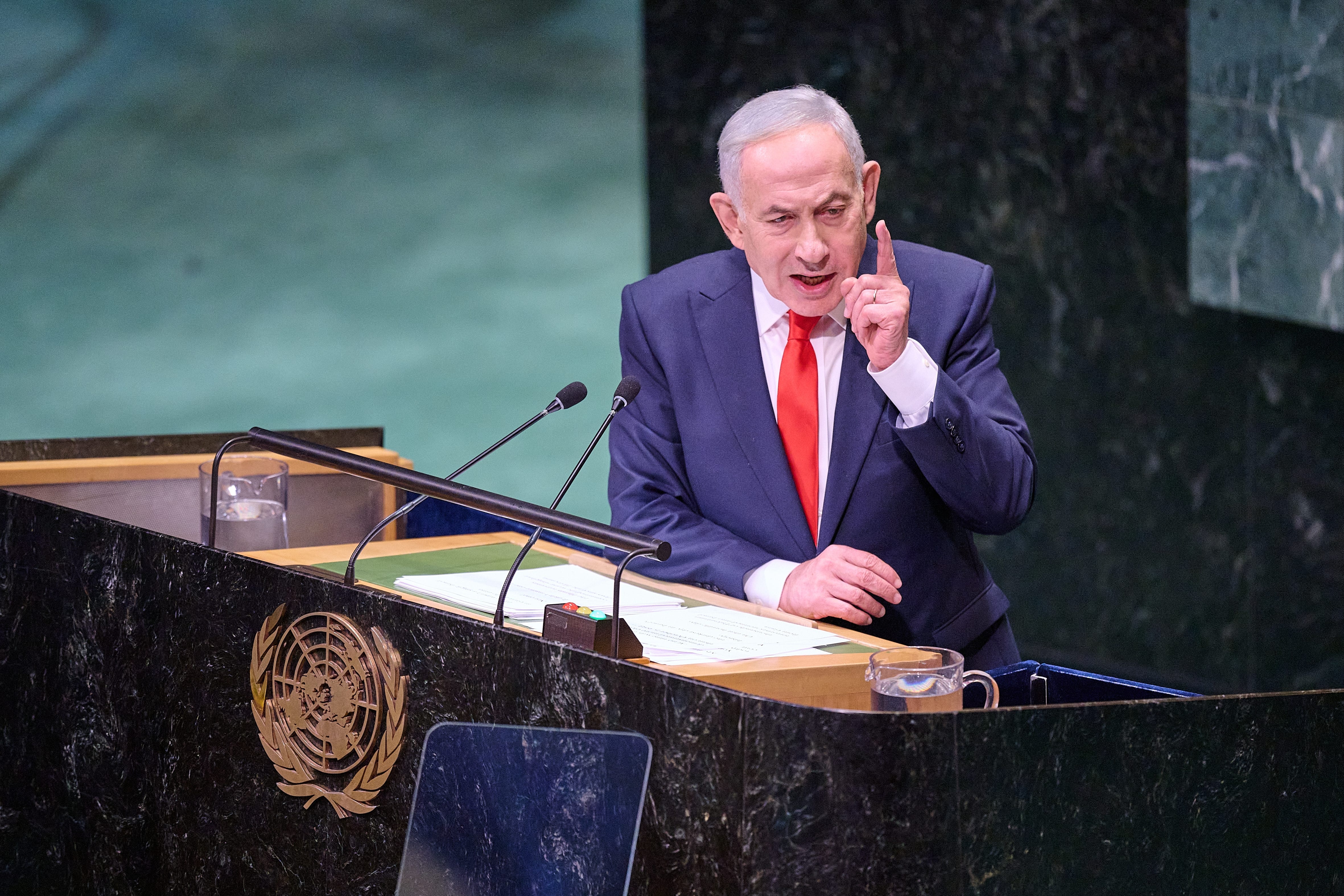
Benjamin Netanyahu came to New York last week and delivered a speech at the United Nations. But let’s be clear about what we were watching: first and foremost, a political campaign stop meant for his voters at home.
Going after New York Mayor Zohran Mamdani and criticizing his wife’s social media activity from one of the world’s most important stages. Accusing Mamdani of supporting Hamas. Presenting himself as the defender of Jewish New Yorkers against their own mayor, who is much more popular with American Jews than Netanyahu is. All of this served an obvious political purpose back in Israel.
But did it help American Jews? Did it make us safer? Did it strengthen our relationships with our neighbors? Did it help us confront antisemitism?
Absolutely not.
Nor did it contain the slightest suggestion of an attempt to repair Israel’s diplomatic standing.
What it did was give Netanyahu’s right-wing voters another performance of the leader they want to see: defiant, commanding the world’s attention, standing up to Israel’s enemies and telling its critics exactly where to shove it. That might feel good, but as we see with Israel’s increasing international isolation, it doesn’t actually make Israel safer.
Too many people in Israel, especially on the right, have a distorted picture of the American political landscape and of American Jews – one Netanyahu is happy to play to. When I was last in Israel a political opinion expert told me that most Israelis think the people opposing the Israeli government’s policies in America are all “blue-haired hippies.” (Full disclosure: my daughter has blue hair. Though I don’t think she’d consider herself a hippie).
But the caricature captures a serious problem. When just 37% of Americans approve of Israel, and 60% disapprove of it, it has a much bigger image problem than just a few left wing activists. And when every single Democrat with the exception of John Fetterman votes on legislation that would force the State Department to produce reports on Israeli human rights abuses in the West Bank, the erosion of unconditional support for Israeli policies is a much bigger problem than most Israelis realize.
Netanyahu’s performance makes more sense when you recognize that persuading, engaging with, or defending most American Jews is not part of his strategy.
Years ago, he and his allies made a political calculation: prioritize Republicans and evangelical Christians, and accept the alienation of liberal American Jews. His longtime confidant Ron Dermer has acknowledged as much publicly and has been saying it privately for years, arguing that Israel should prioritize evangelical support and describing evangelicals as the backbone of its support in the United States.
From that perspective, American Jews who vote Democratic, oppose his government and insist that supporting Israel does not require defending everything it does become a constituency he can afford to dismiss.
Netanyahu’s Politics, Our Problem
Yet Bibi still invokes our safety to justify his politics.
That is what makes this so infuriating. He claims the authority to speak for American Jews while showing so little regard for the consequences we face.
And Netanyahu’s dismissal of our concerns does not shield us from the antagonism toward the State of Israel and its supporters that his policies and rhetoric help fuel.
On the night of the speech, a friend of mine was at a concert in New York and the performer shouted from the stage, “F*** Netanyahu.”
That anecdote is not evidence of antisemitism. Anger at Netanyahu is not the same thing as hatred of Jews. And coming the day Netanyahu publicly railed against the popular mayor of New York City, it should come as no surprise.
But it illustrates how far he has penetrated American public life. His name recognition is at the very top of the list of foreign leaders in the U.S. His name now turns up at a concert, far from a diplomatic meeting or a debate about foreign policy. For Netanyahu, that visibility may be something to boast about. And indeed he has been bragging to his voters that he has been on U.S. Sunday shows hundreds of times “defending” Israel.
For American Jews, this creates both deep discomfort and real dangers.
The danger comes when Netanyahu himself insists on presenting his government, Israel and Jews everywhere as one and the same. He has spent years establishing himself as the embodiment and defender of Israel on the American stage. By also claiming the mantle of fighting global antisemitism – and intentionally conflating criticism of Israel with antisemitism – he drags American Jews into his political fight. That encourages precisely the conflation we need to resist: the idea that American Jews should answer for the actions of an Israeli prime minister.
The responsibility for antisemitism belongs to the people who commit it. Nothing Netanyahu does excuses harassment, threats or violence against Jews. But that does not put his political choices beyond scrutiny. We can condemn antisemitism unequivocally while asking whether a deeply unpopular leader cynically claiming to protect us for his own domestic political purposes is making our lives harder.
I believe he is.
A September survey from the Jewish Electorate Institute found that a majority of American Jews were concerned that Netanyahu’s actions had increased antisemitic and anti-Israel sentiment. The same survey found that 71 percent viewed Israel favorably, while 61 percent viewed Netanyahu unfavorably.
Those numbers should give pause to anyone who equates concern for Israel with loyalty to its prime minister. American Jews can care deeply about Israel and believe that Netanyahu is damaging its future, and ours.
There is also a striking double standard here.
When American Jews weigh in on Israeli politics, criticize settlement expansion or argue for a Palestinian state, we are often told: If you want a say, come live here.
I disagree with that response. Our connection to Israel is real, and so is our stake in its future. And the reality is that the Israeli government’s behavior impacts both U.S. interests and American Jews. We have a right to an opinion, especially about whether the United States supports Israeli policy. But I understand the concern behind it. Israelis live with the consequences of their government’s decisions in ways that those of us abroad do not.
That principle ought to run both ways.
If Israelis want American Jews to respect the realities of their lives, their prime minister should show some respect for the realities of ours. He should understand that we have our own safety concerns, our own political judgments, our own relationships and our own responsibilities as American citizens. And when he shows up here antagonizing popular American politicians and pretending to show concern for American Jews in order to score political points at home, he is doing the opposite of all of that.
Perhaps Netanyahu once believed that his interventions in American politics served Israel’s interests. But whatever the original rationale, it is clear today that his political survival takes priority over the damage he leaves behind – whether in the United States or in Israel.
Israel needs broad and durable support in the United States. American Jews need leaders who take our safety seriously enough to listen to us. Neither interest is served by turning the United Nations into a campaign rally and Jewish anxiety into campaign material.
Netanyahu may have gotten the footage he wanted for his voters back home. American Jews are left to navigate the aftermath.
He needs to stop using us as props and get out of American politics.
Wait! Before you go ...
J Street relies on grassroots support to fuel our mission: Fighting for Israeli-Palestinian peace and providing a political home for American Jews.
We don’t have right-wing mega-donors, we have you. So every dollar makes a difference!
On the mark, Ilan. Indeed it is important to clarify that Netanyahu and his government do not speak for the majority of American Jews. I am also glad you noted the support of some in the evangelical Christian community who identify with Netanyahu's policies. Many in that camp fund the Settler Movement along with other right wing policies in the US.
I do think our language is an obstacle to making vital distinctions among segments of larger groups. They and We, Us and Them... fine distinctions could help to mitigate anti-semitism and other xenophobia.
Again, thank you for your strong statement!
Powerful essay. Netanyahu's effort to turn New Yorkers against their mayor is reminiscent of his 2015 effort to turn the United States Congress against our president. He does seem to look down on us Americans as inferior to His Royal Highness.
The attempt of Netanyahu, and some prominent Jews in this country, to equate Israel with all Jews, thereby holding us all responsible for Israel's actions, does endanger Jews around the world. I am thinking as an example of the man from Lebanon, who lost relatives in an Israeli airstrike, ramming his vehicle into a Michigan synagogue as an act of apparent retaliation. I am not defending or condoning his actions, just pointing out the effects of this rhetoric.